Skip to content
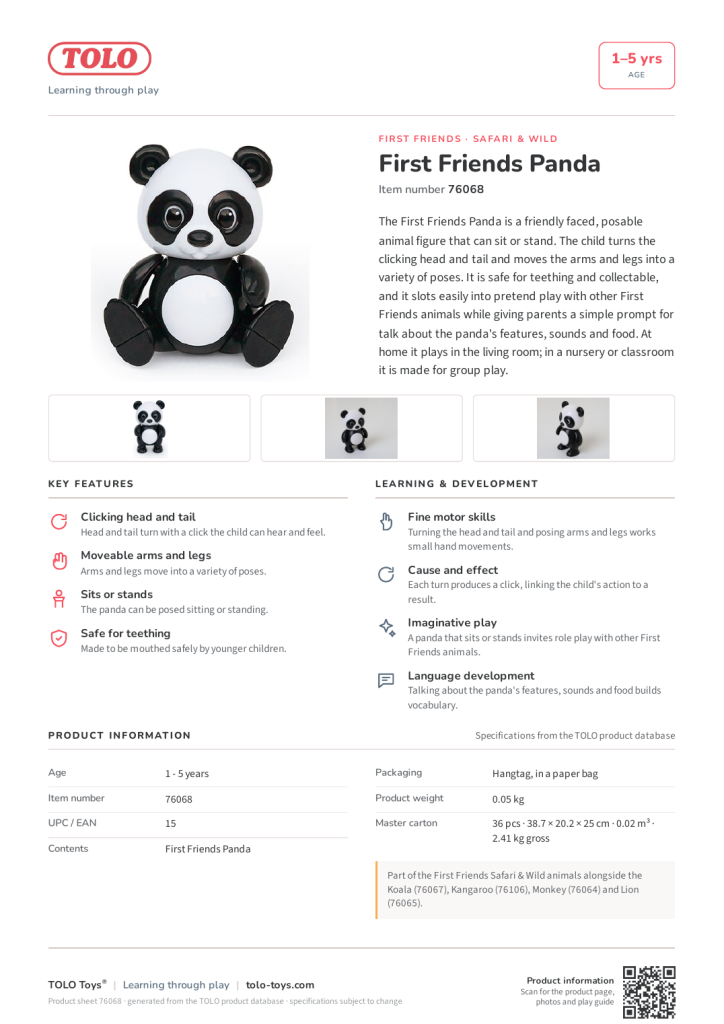
Tolo First Friends Panda, article 76068
See it in actionDemo video · how the Panda is played with

Panda

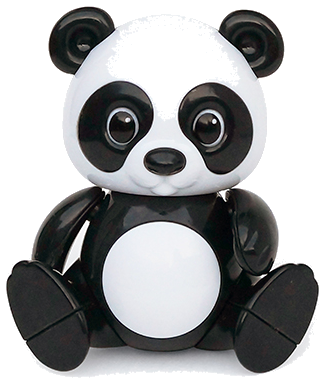
The First Friends Panda is a friendly faced, posable animal figure that can sit or stand. The child turns the clicking head and tail and moves the arms and legs into a variety of poses. It is safe for teething and collectable, and it slots easily into pretend play with other First Friends animals while giving parents a simple prompt for talk about the panda's features, sounds and food. At home it plays in the living room; in a nursery or classroom it is made for group play.

Item number 76068 · EAN 0019287760682
Key features
Clicking head and tail
Head and tail turn with a click the child can hear and feel.
Moveable arms and legs
Arms and legs move into a variety of poses.
Sits or stands
The panda can be posed sitting or standing.
Safe for teething
Made to be mouthed safely by younger children.
Learning & development
Fine motor skills
Turning the head and tail and posing arms and legs works small hand movements.
Cause and effect
Each turn produces a click, linking the child's action to a result.
Imaginative play
A panda that sits or stands invites role play with other First Friends animals.
Language development
Talking about the panda's features, sounds and food builds vocabulary.
Playguide

How to play and learn

Written by Tolo for parents and early-years staff: what to do with the toy, and what the child is learning while doing it.

1–5 YEARS
1Let your child explore the toy and find out which features move and make a sound - if necessary assist and show them all the moving, clicking parts.
2Ask your child simple questions such as 'can you make the head move?'
3Encourage your child to imitate any sounds the animals might make.
4Encourage imaginative play in combination with other items from the First Friends collection.
5Talk about the animal in terms of size, colour, sounds they make and features they have such as mane, tail, hooves, claws, ears, etc.
6Show them pictures/photos of animals in books and encourage them to recognise the similar features of image and toy.
18 MONTHS +
7Introduce vocabulary such as ‘sitting’ ‘running’ ‘barking’ ‘mooing’ etc according to the different actions and sounds the animals can demonstrate as you play together.
8Talk about where you might see the animals - eg in the wild, on a farm, in a zoo etc.
9Compare the toy animals with their real life counter-parts in books, on the television or in real life.
10Show your child the similarities - eg, 'the elephant has big ears, just like your First Friends elephant'
11Ask your child if he or she has a favourite animal and find out what he or she likes about that animal.
12Encourage your child to talk about the animal's different features and abilities.
13Encourage lots of pretend play with the animals, letting your child take the lead, but assisting with ideas if necessary.
14Compare the animal's features and abilities to your own or that of your child e.g. ‘Can Mummy run as fast as the cheetah?’, ‘do you have as many teeth as the crocodile?’, ‘who has bigger ears, you or an elephant?’
15Talk about what the animals might eat - eg 'the giraffe likes to munch on leaves from a tall tree'

Specification

Item number
76068
Age
1 - 5 years
Contents
First Friends Panda
Product size
5.5 × 4.5 × 9 cm
Packaging
Hangtag, paper bag
Weight
0.051 kg
EAN
0019287760682
Range
First Friends
Trade information

Master carton 36 pcs · 38.7 × 20.2 × 25 cm · 0.02 m³ · 2.41 kg gross · UPC #VALUE!

Built to last

Wipe-clean, no fabric, no decals to peel. Designed for shared use in group settings, and to be handed down rather than replaced.

Safety

Tested to EN71, ASTM and CPSIA. Smooth surfaces, no sharp edges, no batteries required.

Product sheet
One-page A4 data sheet: description, key features, learning & development, specifications, EAN.